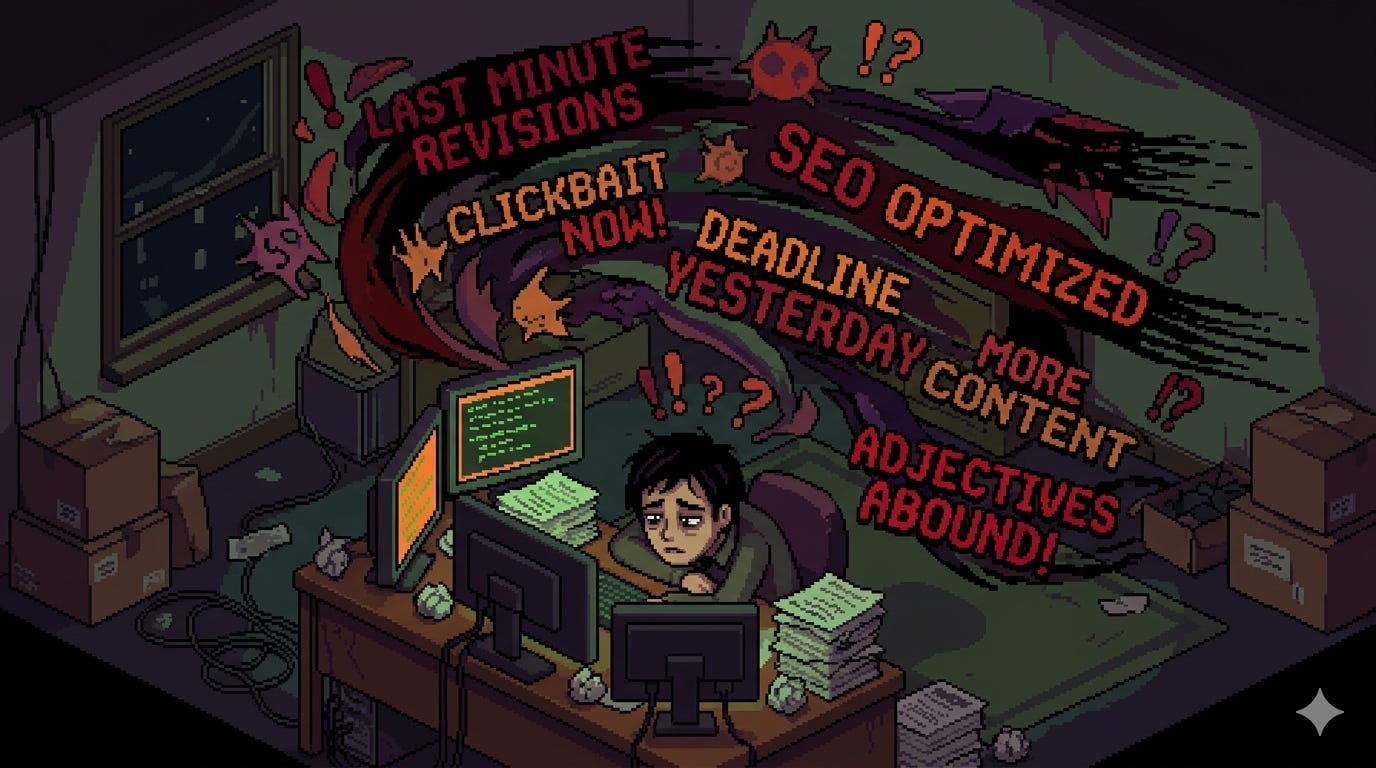
Copywriters Cacophony Pt. 1
How to make your copy stick out like a sore thumb in a crowded market without screaming like a giant man child
Most copywriting sounds like hyperactive carnival barkers shouting about miracles. The customers see right through the hype and ignore the bullshit. But not to worry, all you need to do is lead with one sharp promise written in your customer’s exact everyday language. You don’t get noticed by using louder adjectives, but by standing for something with a distinct voice. Ground your message with facts and proof so readers picture the outcome without feeling tricked. The strongest copy doesn’t scream for attention, it speaks plainly like the most confident person in the room.
A weirdly quiet way to make your voice and offers look unique without resorting to embarrassing hype or fake timers
The amateur marketer shouts at everyone, hoping someone buys. The professional marketer pulls up a chair and speaks directly to one person. I once watched this business owner change his entire company by adopting a quiet signature. When he stopped using fake urgency and started using plain language to name the exact audience, the specific problem, and the real result… Customers didn’t feel shouted at. Instead they felt chosen. You see, clear positioning and a consistent voice beats loud claims every time. You stand out when people instantly know who you are for and who you are not for.
If you want see for yourself, test a tone that’s conversational but not casual, or professional but not patronizing. Think as if you’re talking to your childhood frind during a serious moment. This restraint is memorable, while hype is easily forgotten. Back your claims with proof and tiny details to bake uniqueness into every touchpoint.
How to inject hyper-specific details into your text so it hits your reader right between the eyes instead of sounding derivitive
The average marketer tells you their software will save you time and get you better results… At this point, I’d be suprised if the didn’t. The professional marketer tells you their software cuts the 47-minute admin slog down to 12 minutes. So how do you not day the same thing as them? First, stop using AI. Next stop promising vague success. They describe the exact moment you finally close those 14 open browser tabs before the 5:00 PM deadline.
You don’t need a paragraph of garnish to fix generic writing. Rewrite one sentence at a time and add just one concrete detail. hell, that’s what I’m doing now as I write. Name the exact friction your customer feels. Specificity signals confidence and makes your promise credible. Tie the sharp detail directly to your offer. And keep the language plain. A sharp detail is a quiet gut-punch to the reader and generic is just a waste of ink.
One simple contrarian action you can take in your emails today that your gutless competitors are too terrified to try
Most marketers believe adding more urgency fixes a weak offer, but slapping a countdown timer on a bad product just speeds up the rejection. If the audience doesn’t want what you are selling, screaming that time is running out only makes you look desperate. A numerologist I know ran a campaign for a failing offer and doubled the online content with fake deadlines, yet sales completely flatlined because the core offer was broken.
This contrarian angle works because it interrupts the usual marketing voice pattern and earns attention without sounding abrasive. Keeping your tone calm, specific, and backed by your actual experience so you sound insightful instead of argumentative. Make your hooks a clean contrarian thesis, then use the body copy to explain exactly why the conventional tactic fails in your niche. Avoid fake urgency, inflated claims, and cheap theatrics, because the credibility loss is always bigger than the short-term click. The best contrarian content feel like a sharp correction from someone who actually knows the terrain.
How to deliberately alienate the bottom-feeders and tire-kickers so the highest-paying clients flock to your list
You don’t need to repel people with arrogance, you just need to qualify hard and make the process feel expensive to enter for anyone who isn’t serious. Ask for two specifics up front like a budget range or the exact problem they need solved, because low-fit leads stall when you require the basics. State your standard plainly by naming who you help, who you don’t help, and what kind of client fits your model. This screens out the dabblers without any drama or unnecessary theater. Use a tight, small-lift call to action like a short application or a direct prompt to reply with one specific word. Pre-qualification removes the junk before it eats your valuable time. If a prospect looks shaky, move them into nurture instead of forcing a sales conversation. Low-intent leads are better delayed than chased. And the smartest way to attract higher-paying clients is to make your standards visible and your offer specific, so the right people lean in while the wrong ones quietly bounce.
Thank you for reading part 1.
Part two coming soon,
If you’re tired of the Copywriters Cacophony, you should definatly buy my book L.O.A.P. Marketing so that you can the “Pick Me” company that everyone looks for, by showing you how to be a devils advocate to increase your clients LTV.
Ric Forbes
Written by Ric Forbes with first-hand expertise. AI tools may be used for research and drafting assistance, but all content is reviewed, verified, and published by the author.