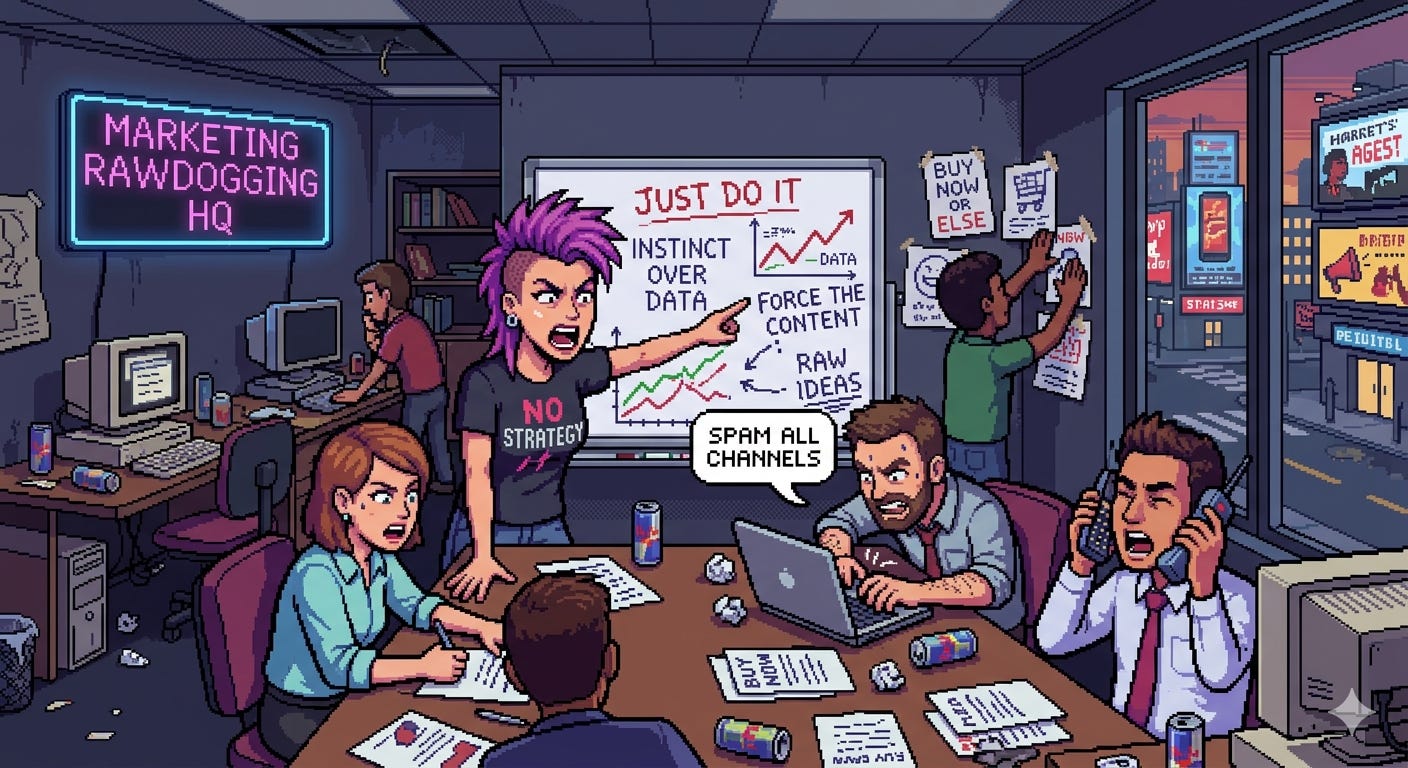
Rawdog Marketing & the Unhinged 24-Hour Ad Loop That Siphons Cash from Corrupted Algorithms Before They Can Bleed You Dry
Here’s the idea in plain English, and it is going to sound unhinged when you first hear it…
You run a paid ad campaign for exactly one day, duplicate it right before midnight, delete the original regardless of how well it was performing, and then wake up and do the whole thing again. Completely skipping the learning phase, without letting the algorithm warm up.
People inside media buying communities are calling this marketing rawdogging and before you roll your eyes and go back to your split-testing spreadsheet, you should know that some of these people are reporting a sustained 6x ROAS over two consecutive months using nothing but this approach. To quote everyones beloved AI “No fluff, no theory.” That’s a pattern, and patterns deserve attention even when they are inconvenient.
“The whole strategy is built on one uncomfortable premise: that the platform’s algorithm is not your business partner and never was.” - Reddit user
The questions this strategy raises aren’t small ones, and they aren’t stupid ones either. They go right to the heart of what paid advertising actually is and whether the conventional wisdom you have been following (the “give it time,” “trust the data,” “feed the algorithm” advice) is genuinely useful guidance or just a very polished way of keeping you dependent on a system that is largely designed against you.
The Ten Brutal Questions From The Front Lines Of The Rawdogging Revolution That Every Lazy Template Addict Is Terrified To Answer Honestly
Why Does Your Best Campaign Turn Into a Corpse After 72 Hours?
This is the frustration that started the whole conversation, and it’s real. Advertisers are watching campaigns launch with genuinely profitable ROAS numbers and then watching those same campaigns produce nothing (not fewer sales, but zero sales) within three days. The rawdogging crowd answers that the “initial optimization wave” is a real phenomenon and that once a campaign rides past it, the algorithm stops delivering your ad to the people who were actually going to buy, because now it has “learned” from a data set that is increasingly polluted. Whether or not that explanation is technically accurate, the pattern it describes is documented by too many people in too many niches to dismiss.
Is “Ad Fatigue” a Real Phenomenon or Just the Platform Making Excuses for Its Own Garbage?
The official story is that your creative gets “exhausted” way too fast and you need to constantly produce fresh content to keep performing. The rawdogging crowd finds this laughable when applied to small daily budgets, and they have a point. The idea that a $50-a-day campaign has saturated an entire target demographic in 48 hours isn’t mathematically serious, and yet advertisers get told this with a straight face all the time. The real question’s whether creative exhaustion is a genuine audience psychology phenomenon or a convenient narrative that keeps advertisers on the content treadmill and the platform’s revenue growing.
Are Bots Devouring Your Conversions and Training the Algorithm to Send You More Bots?
Some people in these communities believe the real culprit behind campaign decay isn’t audience exhaustion at all but automated click fraud. The theory works like this: bots click your ads and generate fake conversion signals (spam leads, abandoned carts, ghost purchases) and the platform’s pixel treats these as valid training data, which then teaches the algorithm to find more people who behave like those bots. And that produces more fake signals that degrades campaign quality further in a compounding loop. It’s hard to prove and harder to disprove, but it does explain why some advertisers see dramatic improvements when they add third-party bot filtering to their stack.
How Do You Actually Keep Fake Clicks From Poisoning the Well?
If the bot theory has any merit, then the logical follow-up is how to stop it from happening. And the answer the community lands on most often involves third-party click fraud protection tools that sit between the platform and your pixel, filtering out non-human traffic before it ever gets counted as a conversion signal. The goal’s to make sure the algorithm is only being trained by real human behavior and genuine purchase intent, so that whatever “learning” happens is actually useful learning instead of derivitive crap that kills performance. This is one of the few places where the rawdogging community and conventional advertising wisdom actually overlap.
Is the Platform Basically a Casino That Deals You a Hot Hand to Get You Addicted Before It Cleans You Out?
Here’s probably the most cynical reading and also the most rhetorically satisfying one. The theory is that platforms deliberately feed new campaigns artificially cheap, high-quality traffic to hook advertisers on the initial results, and then gradually degrade that traffic quality in the days that follow, clawing back the margin while the advertiser keeps spending in hopes of returning to that original performance. Whether this is intentional design or simply an unintended consequence of how optimization systems work is almost beside the point. Because the practical effect on your business is the same either way, and the rawdogging approach treats both scenarios identically.
Does Running Ads With Zero Social Proof Make You Look Like an Amateur, or Does It Not Actually Matter?
When you delete and duplicate campaigns every day, you are wiping out all the accumulated likes, comments, and shares that ad platforms use as social validation signals. The concern is that ads with no engagement history look untrustworthy to potential buyers and hurt conversion rates accordingly. Interestingly, the rawdogging practitioners who have looked at this closely report noticing that even high-performing competitor ads often show suspiciously low engagement numbers on active campaigns. Which raises the question of whether social proof on ads matters nearly as much as marketers have been told it does or whether it’s another metric that sounds important but doesn’t actually drive purchase decisions.
If the Machine Needs Time to Learn, Why Does Resetting It Every Night Work Better Than Letting It Run?
Standard platform advice is built on the premise that machine learning needs stable, consistent data over time to exit the “learning phase” and start finding your best buyers efficiently. The rawdogging strategy is a direct contradiction of that advice, and it appears to produce better results for at least some advertisers. And that’s a problem for the official narrative. The most honest explanation is that the learning phase might be genuinely useful for certain campaign types and budgets while being actively counterproductive in others and that the blanket recommendation to “let the algorithm learn” isn’t actually good advice… but rather default advice that keeps advertisers patient while the platform collects data it can use for its own purposes.
Are You Just Hammering the Same Thin Slice of Buyers Over and Over Until You Bleed Them Dry?
There’s a legitimate structural concern here about audience depth, and it deserves a real answer rather than a dismissal. If every reset triggers the algorithm to target the same high-intent, easy-to-convert segment of your audience (the “low-hanging fruit” who were going to buy anyway) then you might be achieving short-term ROAS numbers that look great on paper while systematically failing to penetrate deeper into the market and build any real scale. The rawdogging community hasn’t fully resolved this one, and the honest ones will admit it, which is more intellectual honesty than you get from most ad gurus who pretend their strategies have no tradeoffs.
Is the “Test Ten Thousand Creatives” Dogma Just a Distraction From the Fact That the Algorithm Is Broken?
The rawdogging strategy is notable for cycling the exact same creative repeatedly and reporting consistent results. This is a direct challenge to the modern media buying orthodoxy that demands constant creative production and testing at scale. If the same ad keeps working when you reset the campaign container rather than the ad itself, then the creative was never the problem… and all the time, money, and energy spent producing endless new content variants may have been solving the wrong problem entirely. This doesn’t mean creative quality is irrelevant. But it does suggest that the emphasis placed on creative volume as the primary lever for improving performance is worth questioning a lot more aggressively than most people do.
Is This a Legitimate Business Strategy or Just a Loophole That Gets Patched the Moment Enough People Start Using It?
This is probably the only question where both sides of the debate reach roughly the same conclusion, though they describe it differently. The skeptics say it’s an exploit that will eventually be patched and that building a business on it is foolish. The practitioners say it might be temporary, but it works now, and “now” is the only time they can actually use to grow a business. The more honest framing is that all media buying strategies have a shelf life, and the question is never whether something will eventually stop working, but whether you understand why it works well enough to adapt when the conditions change. And most people running rawdogging campaigns have thought harder about those underlying mechanics than the people dismissing them from the sideline.
The uncomfortable truth sitting under all ten of these questions is the same one: the platforms are not your partners, and the default advice they publish isn’t designed to maximize your results. Marketing rawdogging isn’t a perfect strategy, and it is not a philosophy anyone should adopt without understanding what they are trading away. But the questions it raises are legitimate ones, and the people asking them deserve better answers than “trust the algorithm” and “make more content.”
The platforms are blood-sucking digital casinos designed to systematically strip-mine your bank account while clueless corporate ad-idiots order you to submissively feed the algorithm and vomit out endless creative content. Stop letting this brain-dead, automated bot slop paralyze your lead flow and kill your sales.
Grab your copy of the L.O.A.P. marketing book right now to secure the exact 30-day battle plan you need to violently rip out the machine filler, hijack their corrupted data tracking, and force real, flesh-and-blood human buyers to cough up daily cash directly into your business.
Ric Forbes
Written by Ric Forbes with first-hand expertise. AI tools may be used for research and drafting assistance, but all content is reviewed, verified, and published by the author.