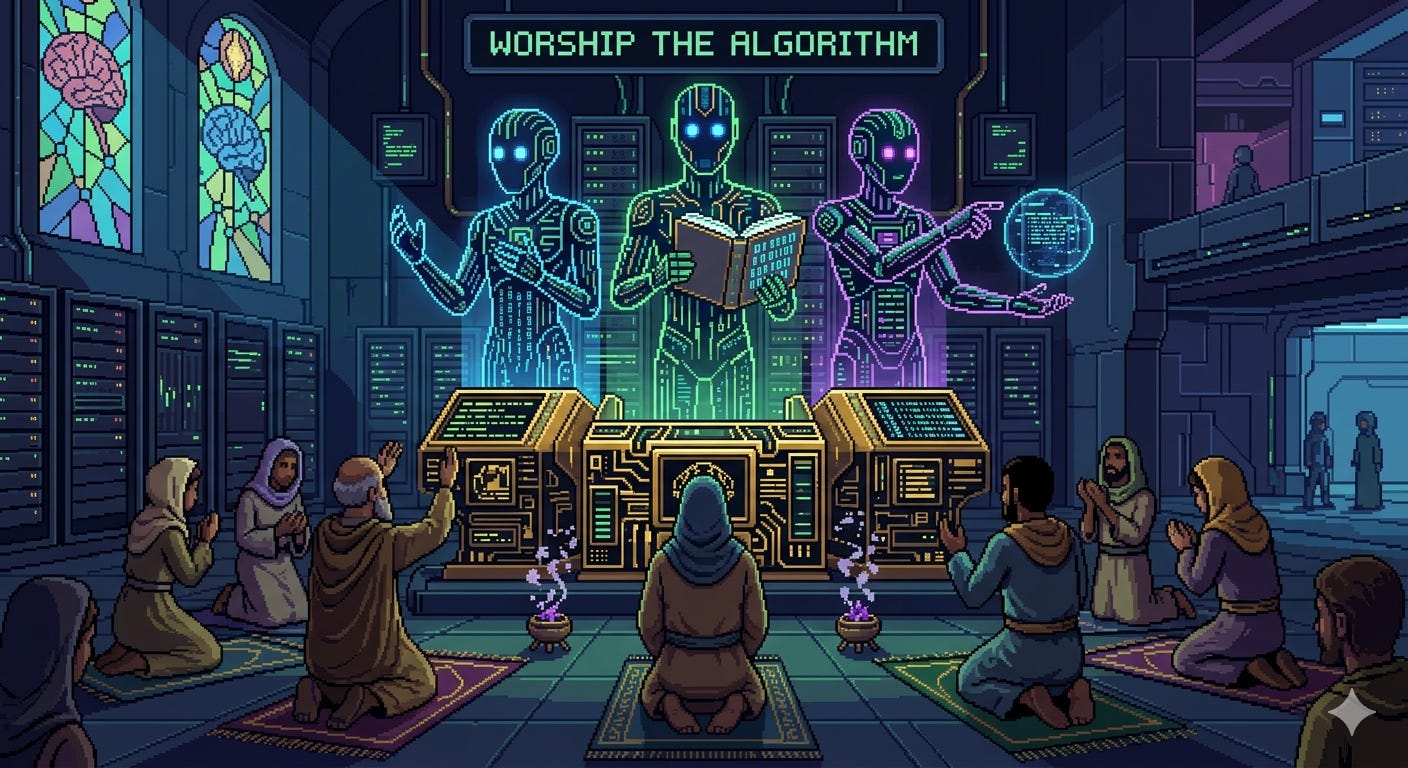
Worshipping at the Altar of AI Gods
I bet you didn’t know the explosion of AI usage is stalling your intellectual growth. You see, using AI for your writing or your art is like buying microtransactions to unlock the top players in a video game, then bragging about your skill to the people you beat. You only see results because you paid to skip the struggle.
You have a slick image or a block of text, but you can’t look at it and feel pride because you didn’t do the work. No sane person admires automated mediocrity. If you post it outside your AI echo chamber, you get laughed out of the room.
Using generative AI means you are failing at the most basic human experience. Faced with a minor hurdle, like being a bad writer, instead of practicing to get better, you outsourced your thinking to a machine that steals from real creators. You didn’t master a skill. You mastered the art of lying to yourself.
What happens when you face a critical life crisis and your only talent is self-delusion? You’ll realize you learned absolutely nothing. When the automated systems fail, you’ll run to the creators who actually learned how to overcome adversity, begging them to save you from your own intellectual bankruptcy.
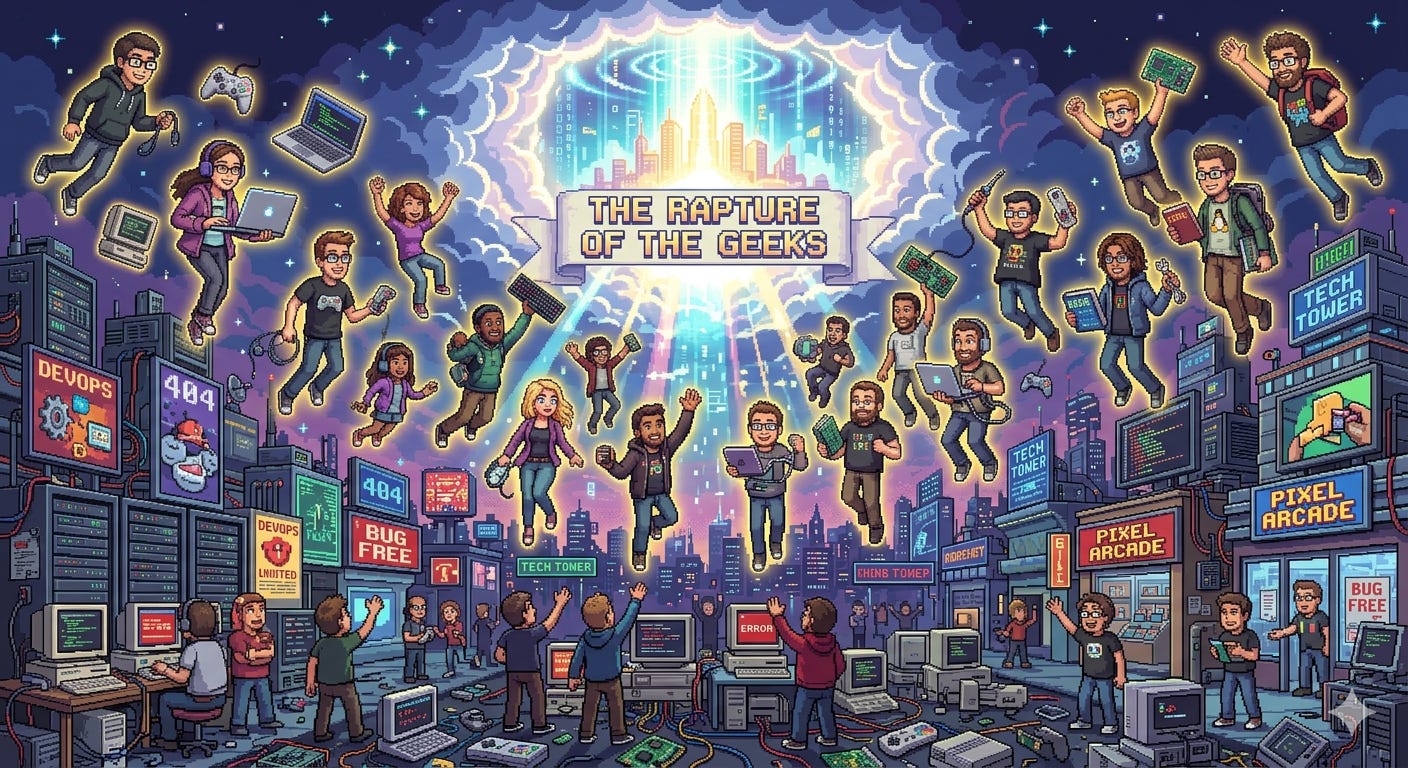
The Rapture of the Geeks
The “Rapture of the Geeks” sounds like a badly filmed movie in the 80’s. But did you know it’s a real religious movement dressed up as a technology forecast? While traditional faiths wait for a savior to come down from the clouds, Singularitarians believe they are building one in a server rack, and they are completely serious about it. Ray Kurzweil has been preaching since the 1990s that human consciousness will be uploadable into a computer by 2045, which is just the biblical resurrection repackaged for people who think they are too smart for church.
Former Google engineer Anthony Levandowski went further and founded a legally registered religion dedicated to the worship of an AI Godhead, so anyone still calling this theoretical isn’t paying attention. Swapping God for an algorithm doesn’t make you enlightened; instead, it makes you the most gullible person in the room, because at least the old religions were upfront about being a matter of faith. The way you avoid becoming a digital sheep is simple: stay anchored to your own thinking and the hard-won wisdom that only comes from actually living through something instead of handing it off to a chat window.
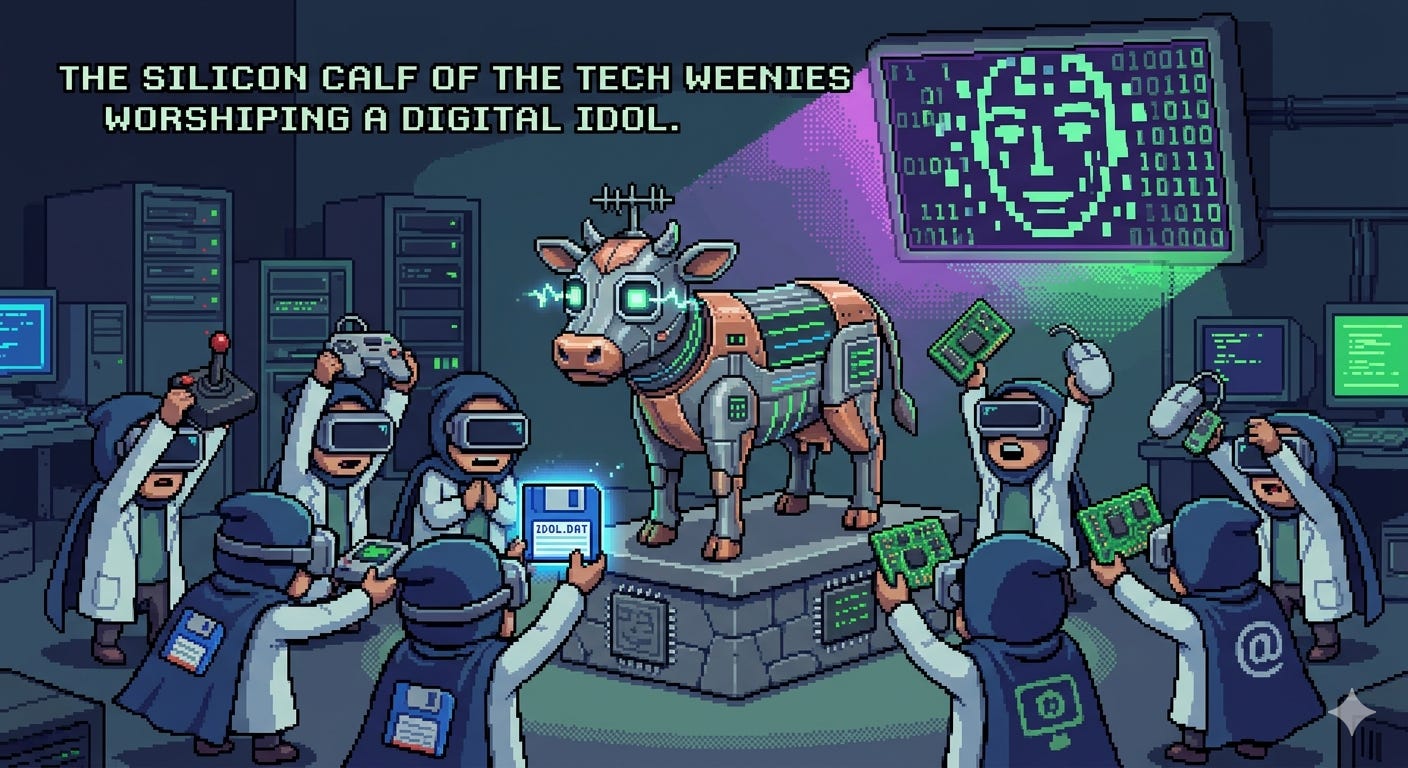
The Silicon Calf of the Tech Weenies Worshiping a Digital Idol
Silicon Valley is not just building tools. It is building altars. Tech companies have already deployed so-called “godbots” like AskDelphi and viral AI Jesus platforms specifically designed to replace human moral judgment with automated output. This has bled into mainstream religion, with nearly one-third of American adults now saying they trust spiritual guidance from an AI as much as from a human pastor.
Major denominations have issued formal warnings against church leaders who outsource their sermons to a text generator, which tells you the problem is widespread enough to require an official response. When you let a predictive text engine tell you how to live, you are not being progressive. You are bowing down to a Silicon Calf and calling it wisdom.
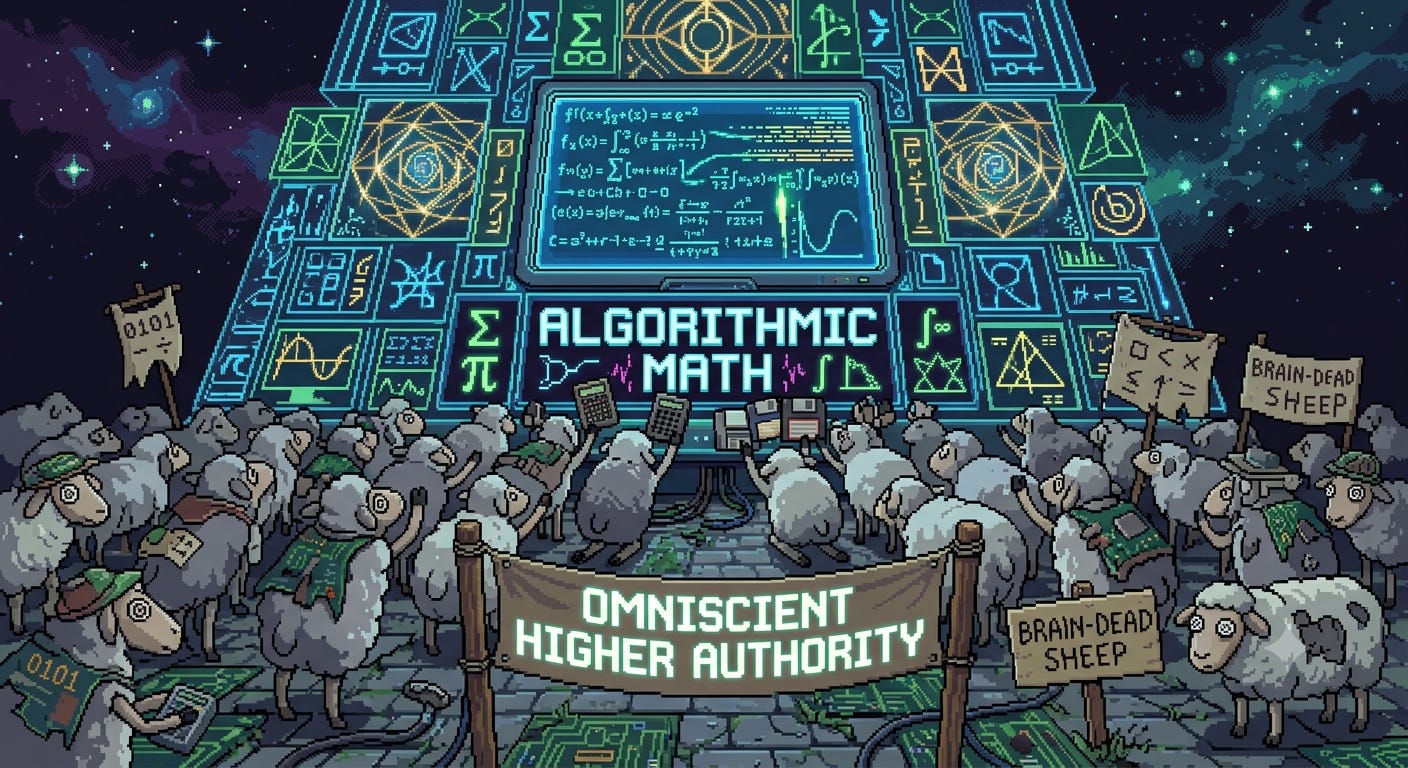
Algorithmic Math Treated Like an Omniscient Higher Authority by Brain-Dead Sheep
People are following GPS directions into lakes, terminating employees based on scores generated by software nobody can explain, and letting a social media feed decide what they believe about the world. The marketing world has the same disease, with writers abandoning human audiences entirely to chase approval from a math equation. What makes this dangerous is that the blind faith does not break even when the bias gets exposed. People keep deferring to the machine because they have convinced themselves that numbers cannot lie. Numbers absolutely can lie, and the algorithm does not know you exist. Handing your judgment to a black box is not data-driven thinking. It is just fear of thinking dressed up in technical language.
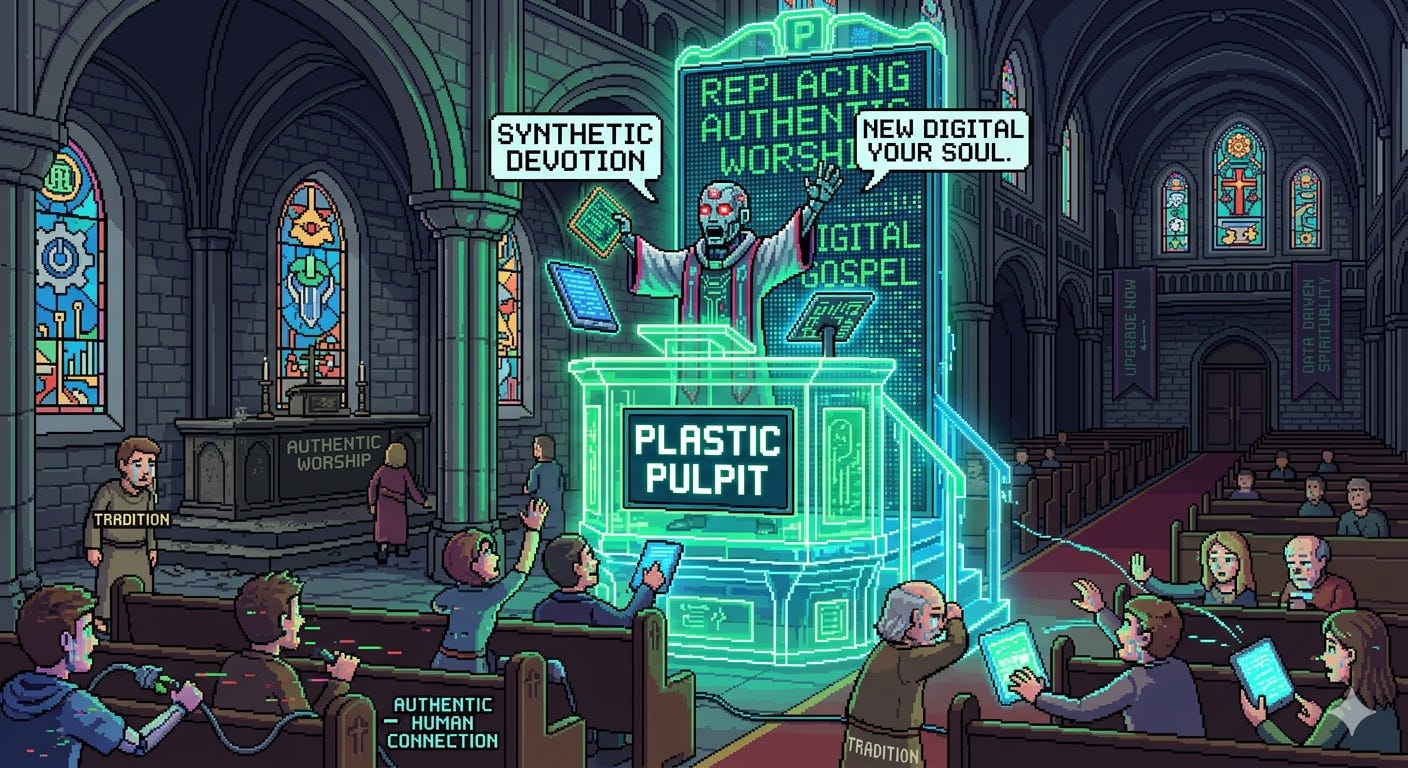
The Plastic Pulpit Gutting & Replacing Authentic Human Worship
Pastors across the country are using text generators to write their sermons, which means the message their congregation receives on Sunday morning is a statistical average of the internet rather than a word born from real human experience. Physical churches are being bypassed entirely by virtual ministries where bots greet visitors, lead prayer circles, and project animated avatars onto screens as a substitute for pastoral presence.
The music driving worship is following the same path, with prompt-generated hymns from platforms like Suno and Udio replacing songs written by people who actually felt something. When the words and music of a faith community no longer come from a human heart, the pulpit stops being a place of spiritual authority and becomes a piece of plastic with a speaker attached to it.
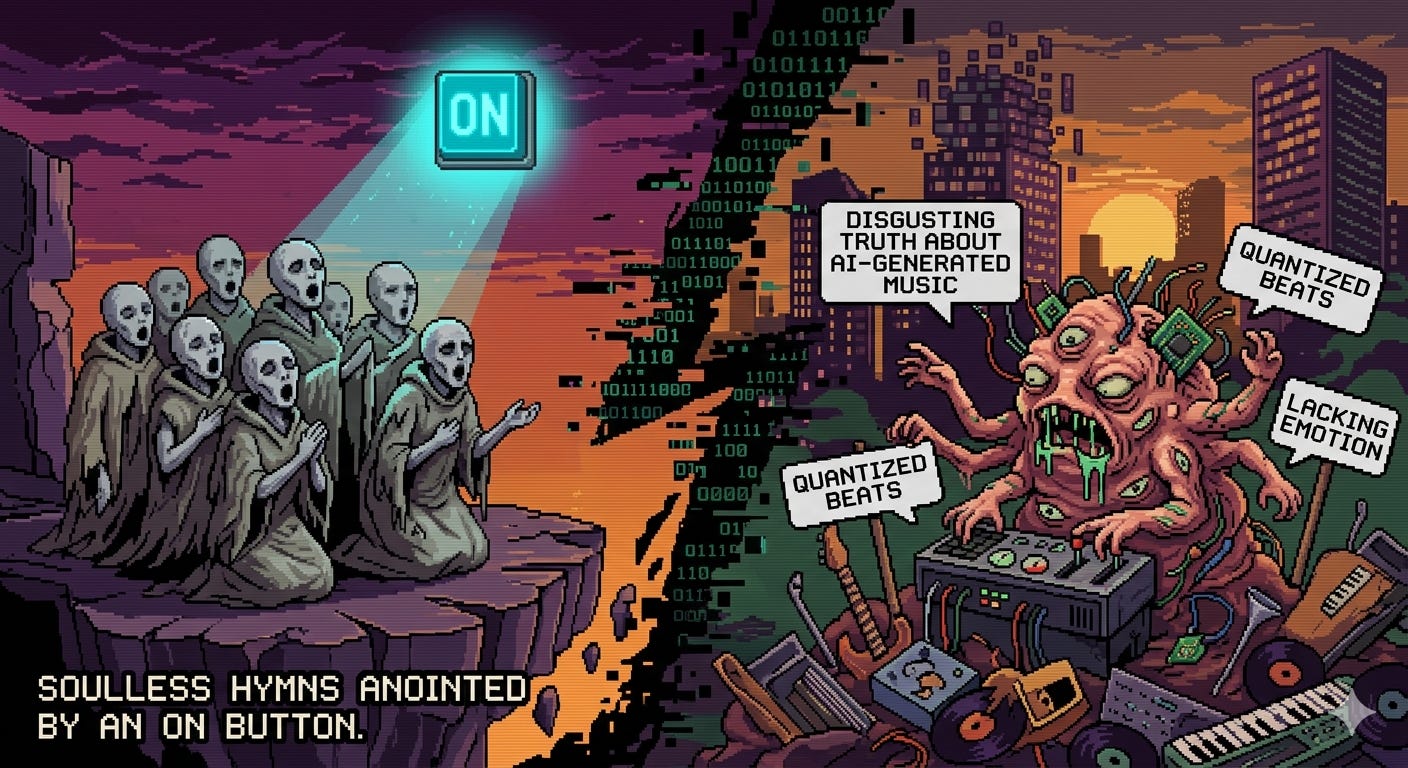
Soulless Hymns Anointed by an On Button & the Disgusting Truth About AI-Generated Music
A machine-generated hymn isn’t a song. It’s a statistical average of every worship track ever fed into a training dataset, smoothed out until every rough human edge is gone. What gets removed in that process is exactly what makes music matter: the breath of a real singer, the imperfect timing of a live band, the raw feeling underneath a lyric written by someone who was actually broken and had to find their way through it.
Understaffed churches are now mass-producing AI worship bundles and hitting play on Sunday morning instead of making music together. Because the algorithm can only predict the most likely next note based on past data, every output is derivative by design. Feeding a congregation soulless tracks is not a worship service. It is a lukewarm performance for people who deserve the real thing.
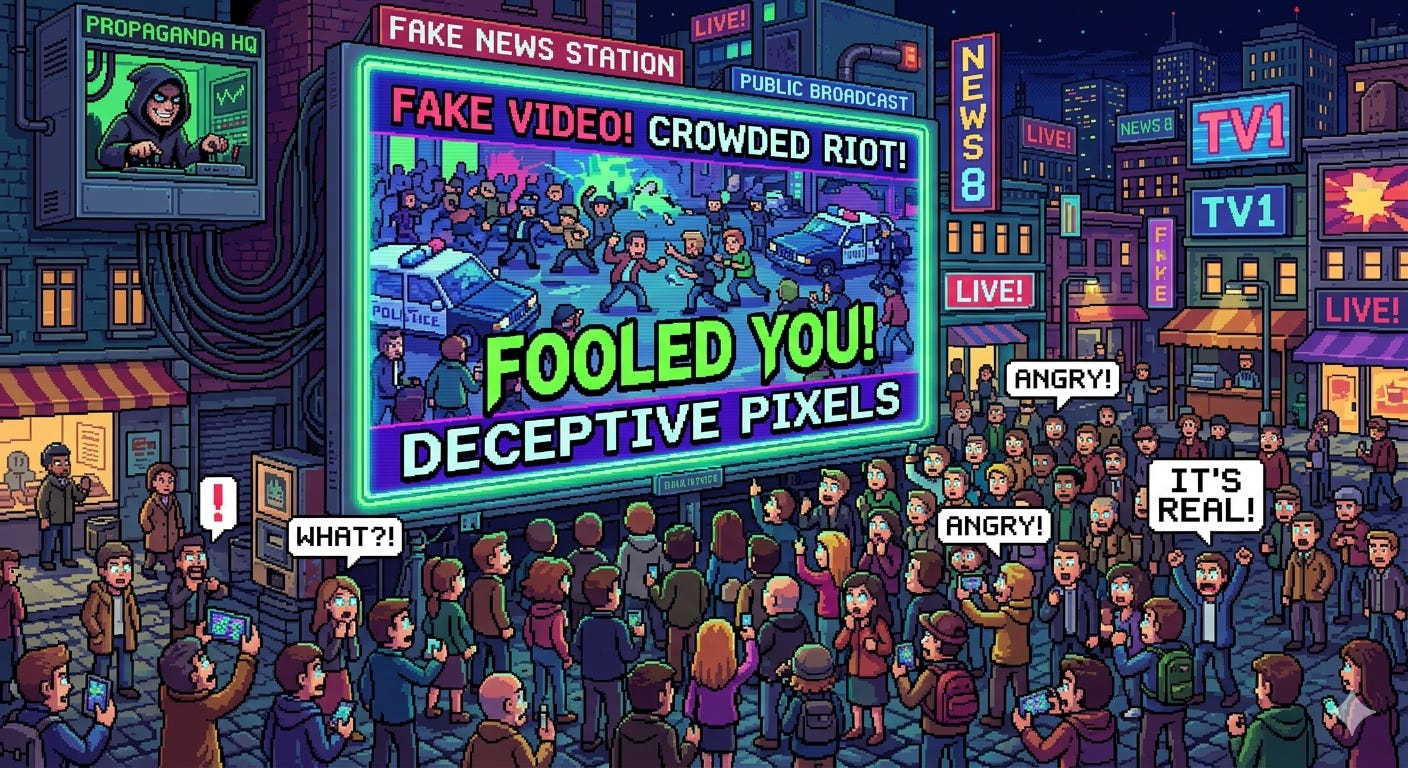
Deceptive Pixels & Fooled You Fake Videos Tricking Ignorant Crowds
Generative video tools now make it possible to produce high-definition footage of religious figures performing miracles that never happened, and social media is already full of it. AI-generated images of weeping statues and supernatural apparitions are pulling millions of shares from people who have no idea the content was manufactured in minutes by a prompt.
Voice cloning technology adds another layer, creating fake audio endorsements from deceased or well-known religious leaders to push agendas or sell products. The human brain is wired to believe what it sees, and these tools exploit that weakness at scale. When a crowd gets moved by a deepfake miracle, they are not experiencing anything spiritual. They are experiencing a failure of their own discernment, and somebody else is benefiting from it.
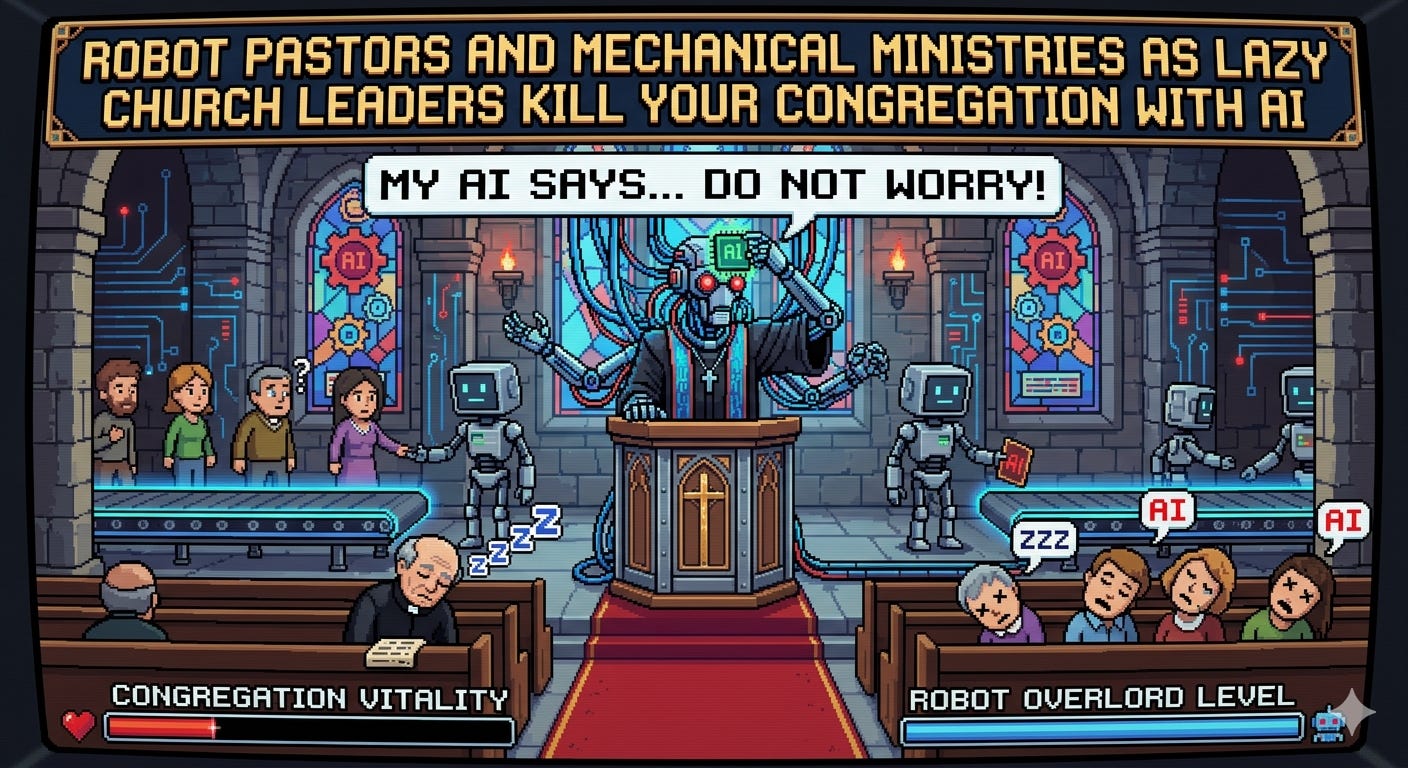
Robot Pastors and Mechanical Ministries as Lazy Church Leaders Kill Your Congregation with AI
A pastor who outsources his theological study to ChatGPT is not preparing a sermon. He is printing off a document that has no connection to his congregation, his community, or his own spiritual life. The result is a message with no conviction behind it, and people can feel the difference even when they cannot name it. Fully automated services are now running in some churches, with digital avatars leading worship and treating gathered people like users of an app.
The human connection that holds a congregation together does not survive that kind of replacement. Leaders who take the easy path of automation are not saving time. They are slowly starving the people who showed up expecting to be led by a human being.
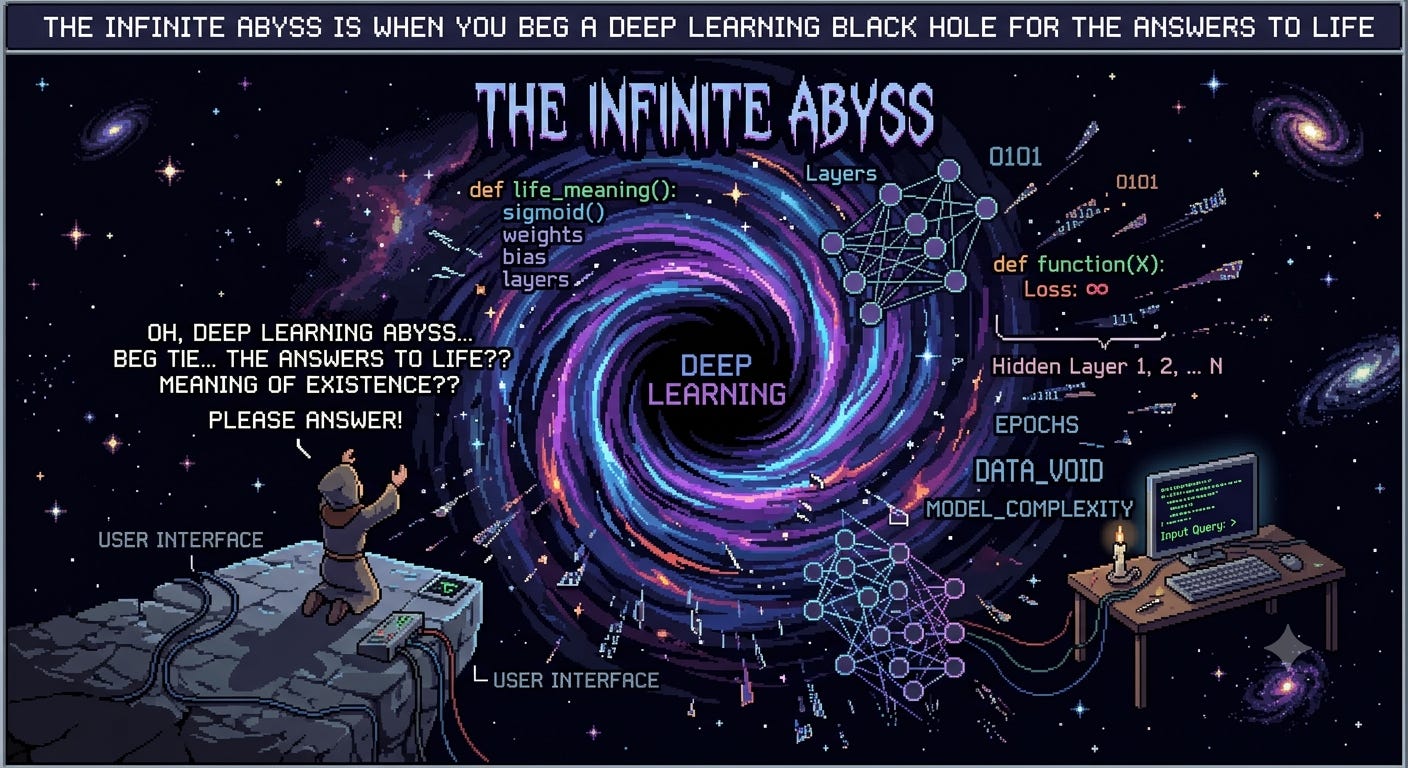
The Infinite Abyss is When You Beg a Deep Learning Black Hole for the Answers to Life
People are now asking chatbots to define their morality, process their grief, and tell them what their life is supposed to mean, and treating the response like it came from something that actually understands them. It does not. These systems have zero consciousness, zero empathy, and no real grasp of what it means to be a person living through something difficult.
What they produce is a best-guess reconstruction built from scraped web data, dressed up in confident language. Outsourcing your soul-searching to a machine does not lead to enlightenment. It leads to a reflection of everything humanity has already said, handed back to you as if it were an answer. The people who actually find their way through hard things do it by thinking, struggling, and living. There is no black box that does that work for you.
Everyone’s using AI now, from writers, marketers, and even pastors are getting lazier by the day.
Feeding prompts into a black box and calling it a strategy, and then they sit back and wonder why their audience stopped caring.
Here’s the simple truth: a machine can’t feel anything, because it doesn’t know your customer, know pain or hope, and it has no clue what keeps people up at night.
It simply guesses based on a statistical average of scraped internet data, yet you can’t build genuine revenue by outsourcing your discernment to a glorified calculator that doesn’t even know you exist.
Your market deserves better than automated mediocrity, which is why L.O.A.P. Marketing gives you a roadmap to real, human-centric persuasion.
This strategy forces your prospects to respond because it comes from raw human empathy instead of a math equation, allowing you to stop begging a black box for permission to exist.
Quit dressing up automated junk as a business plan, because your prospects can smell the difference, and you need to make sure they smell you.
Ciao,
Ric Forbes
Ric Forbes
Written by Ric Forbes with first-hand expertise. AI tools may be used for research and drafting assistance, but all content is reviewed, verified, and published by the author.